Project context
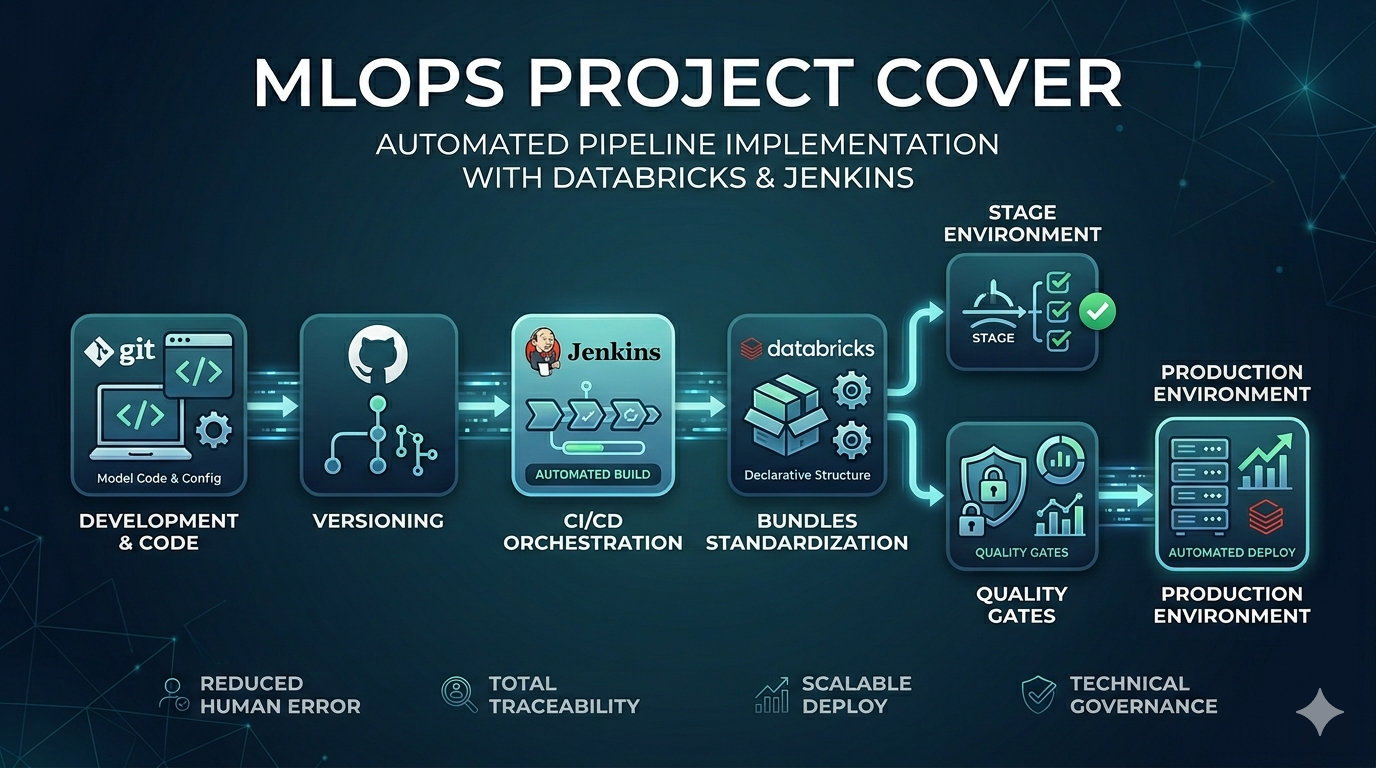
This project aimed to structure and run an MLOps pipeline for deploying machine learning models to production, replacing a manual, lightly governed process with an automated, versioned, and auditable one.
The problem
Before the initiative, the model delivery cycle had important limitations:
- Manual deploys from notebooks.
- No dedicated ML CI/CD for machine learning assets.
- No formal validation before production promotion.
- Low traceability of code, configuration, and artifact versions.
- High human-error risk and environment inconsistency.
That made scaling, technical governance, and operational reliability difficult.
Solution implemented
The solution was end-to-end, focusing on standardization, automation, and safe promotion between environments.
1) Standardized deploy with Databricks Bundles
A Databricks Bundles–based packaging and delivery framework was adopted, providing:
- Declarative structure for job and workflow definitions.
- Code versioned in a repository.
- Environment-based parameters (e.g. dev, staging, production).
- Reproducible deploys without depending on one-off manual runs.
Deployment became configuration- and code-driven, reducing operational variability.
2) CI/CD pipeline with Jenkins
A CI/CD pipeline was built for models and workflows, including:
- Automated triggers on versioning events (e.g. merge to main).
- Build, validation, and controlled release stages.
- Environment promotion with defined criteria.
- Less manual intervention on the path to production.
The combination of version control, Bundles, and Jenkins created a consistent delivery path for new models.
3) Governance and pre-production validation
The new approach added quality gates before production, such as:
- Configuration integrity checks by environment.
- Consistency checks for artifacts and dependencies.
- Approval criteria for promotion.
- Change control and a history of deployed versions.
The result was more predictable, lower-risk production rollouts.
Outcomes
Operations
✅ Significant reduction in manual deploy work.
✅ Lower incidence of operational mistakes.
✅ Higher speed and predictability in model delivery.
Technical
✅ Standardized deployment with a declarative approach.
✅ Reproducibility across environments.
✅ Better traceability of what was deployed, when, and how.
Governance
✅ A process with clear validation and promotion criteria.
✅ Better change control and safer production releases.
✅ A solid base for ongoing MLOps evolution.
Business impact
The initiative increased confidence in model productionization, reduced operational risk, and enabled a more scalable ML operation. With an automated, controlled pipeline, the team could deliver value more often with lower maintenance cost.